There's No Room for Guilt When Scoring Rare Double on Gobblers

Updated: May 18
If I didn't view wild turkeys as nature’s most fickle, frustrating and fascinating bird, I might have felt guilty for shooting a gobbler May 8 as it stood confused while its buddy flapped its last among my decoys.
I suspect that Emily Krumenauer, my hunting buddy and family-friend, frazzled my gobbler’s composure when she shot its running mate seconds earlier with her late father's Model 12 Winchester shotgun. The two big gobblers had spent the previous minute in a murderous rage, attacking my decoys with a flurry of flapping wings, pecking beaks and spurring legs.
Maybe that furious commotion made my gobbler oblivious to the blast of Emily’s 12-gauge at 7 a.m. Whatever the cause, the gobbler didn’t flee even as I shouted congratulations and slapped Emily’s back.
And then I came to my senses, realizing the second gobbler hadn’t fled. It was standing 25 yards away, its head snapping back and forth in confusion. In similar cases, gobblers have always run off or thrashed the gobbler I shot, unmercifully kicking an old buddy while its down.
“Hold these,” I hissed, and shoved my striker and slate-call into Emily’s hands. Grabbing my .22/.410 over/under gun beside me, I cocked its hammer, aimed and dropped the second gobbler with a load of No. 9 tungsten pellets.
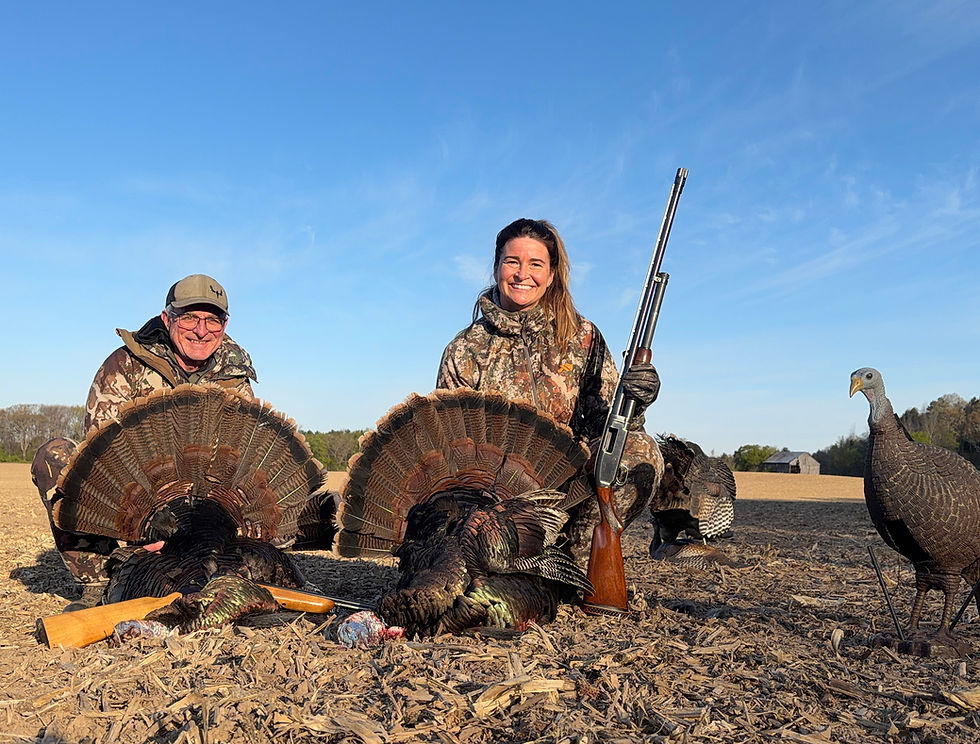
Patrick Durkin and family-friend Emily Krumenauer scored a double on gobblers while hunting May 8 near Chippewa Falls. — Patrick Durkin photos
An hour earlier, neither success had seemed possible as we hunted near her family’s farm in Chippewa County. We had set up the decoys and settled into the camouflage blind. Nothing answered in the gray dawn when I yelped five times on my wingbone call about 5:30 a.m. And so I tried another five yelps. No answer.
Then I pulled out the aluminum-faced slate-call and stroked a series of purrs and clucks. No answer.
I tried again. Still nothing.
Finally, about 6 a.m., we heard gobbles several hundred yards to the northwest. Soon after, Emily pointed out three hens 400 yards due west across the field. And then she got excited.
“I see two white heads way behind them. They must be gobblers.”
I envied her vision while raising my binoculars and focusing where she pointed. Sure enough, two mature gobblers were in full strut, their white heads silhouetted by their fully fanned tails.

I doubted my calling skills could separate the gobblers from their hens, but then again, they weren’t cavorting among them. They trailed the trio by at least 150 yards. The five birds kept walking south along the field edge the next half-hour, but the gobblers didn’t try too hard to close the gap.
I called occasionally, figuring we had nothing to lose, but still believing it was futile. When the two gobblers turned left and started walking toward our setup, I kept quiet. I dared not say anything to Emily for fear of jinxing us. But the gobblers kept marching, leaving the three hens to continue feeding southward down the field’s far edge.
And then the inevitable happened. The gobblers stopped, turned, milled about and stalled 200 yards away. But they hadn’t lost all interest. They gobbled at whatever call I made, their heads and necks shooting forward to gobble, and the sound reaching us a split-second later.
As the stalemate dragged past the 15-minute mark, I tried my best to sound like an impatient hen, calling aggressively with sharp clucks and raspy yelps. I kept at it about 15 seconds, paused a bit, and went after it again, making sure they knew our “hens” meant business.
Amazingly, they fell for it. The two toms finally resumed walking our way, strutting and gobbling. I didn’t have to tell Emily to get ready. Slowly, achingly, she raised Gary Krumenauer’s old shotgun from her lap, its barrel rising up and leveling as its vintage Poly-Choke and muzzle jutted out the blind’s window.
The gobblers were soon just 50 yards away, their scalps snow-white, their faces sky-blue, and their wattles blood-red. They marched side-by-side as if joined at the shoulder, their wingtips dragging the ground, and their tail feathers fanning tall, wide and proud.
Emily held her fire, hoping they’d open some space between them. She knew one shotgun blast could easily kill both. She also hoped one would raise its periscope, inviting her to aim her shotgun bead beneath the junction of its head and neck. She prides herself on shooting no pellets into a turkey’s meaty breast.
And then the gobblers’ beat-down commenced. They took turns attacking the jake decoy and its authentic fantail, crumpling, twisting and breaking off several of its tall feathers. But still they offered no shots, even as one jumped atop the decoy and the other strafed it sideways with its spurs. Meanwhile, a nearby hen decoy became collateral damage as the gobblers brought the fight from all angles.
Finally, one gobbler jumped aside. As it looked around to study things, Emily’s shot cut short its review.
I hadn’t grabbed my gun. Given my incompetence with mouth-calls, I still had both hands on my striker and slate-call to coax the gobblers to raise their heads to present a clear shot.
After I shot and both birds were down, I thought for a second that it had been too easy; that the second gobbler should have fled. That’s what the survivors usually do.
Pfft!
The guilt passed faster than it formed.
Such opportunities seldom happen, as my daughter Leah and I confirmed the next three days after she arrived to hunt. She passed up several shots at jakes, including one with a long, wispy beard. She also passed up a good shot at a bearded hen, whose wispy beard matched the jake’s in length and thickness.
And gobblers? We saw at least one tom nearly every hunt during Leah’s stay, but not one came closer than 120 yards, with or without us deploying our decoys.
Why? Who knows. Many years have passed since I spent much time trying to understand a turkey’s motives.


Comments