Voters at Wisconsin Hearings Support Higher Hunting, Fishing, Trapping Fees

Wisconsin’s outdoors community supports paying more to operate the state’s fish and wildlife programs, but not necessarily at any price.
That’s one point to take from nearly 6,900 votes cast during mid-April’s annual conservation hearings, a statewide effort by the Department of Natural Resources and the citizen-based Wisconsin Conservation Congress. This year’s hearings consisted of in-person meetings April 13 in all 72 county seats, which drew 1,268 attendees; followed by three days of online voting, which drew 5,598 participants.
Voters weighed in on 44 proposals from the DNR, WCC and Natural Resources Board, seven citizens appointed by the governor to set policies for managing Wisconsin's natural resources. None of the votes on April’s questionnaire are binding, and none will take effect this year. However, questions OK’d by voters could advance to the 2027 spring hearings as official proposals if the WCC endorses them at its annual convention May 15-16 in Green Bay.
April’s ballot asked 13 questions about boosting DNR funding to fill massive deficits in the agency’s fish and wildlife accounts. Funding for Wisconsin’s conservation programs has plunged the past 20 years, largely because the Legislature hasn’t increased license fees for residents since 2005, and reduced license prices to as low as $5 for beginners in 2016. Meanwhile, hunting and fishing participation kept sinking, further reducing license sales and revenues. Sales of firearms deer licenses, for example, fell to 550,611 in 2025, a decline of nearly 96,000 (15%) from 646,511 in 2006.
The DNR recently announced plans to cut stocking for muskies by 70% and walleyes by 45%. It also halted fish rearing at two state hatcheries, resulting in 500,000 fewer game fish. In addition, the agency announced cuts to survey work and pheasant stocking.
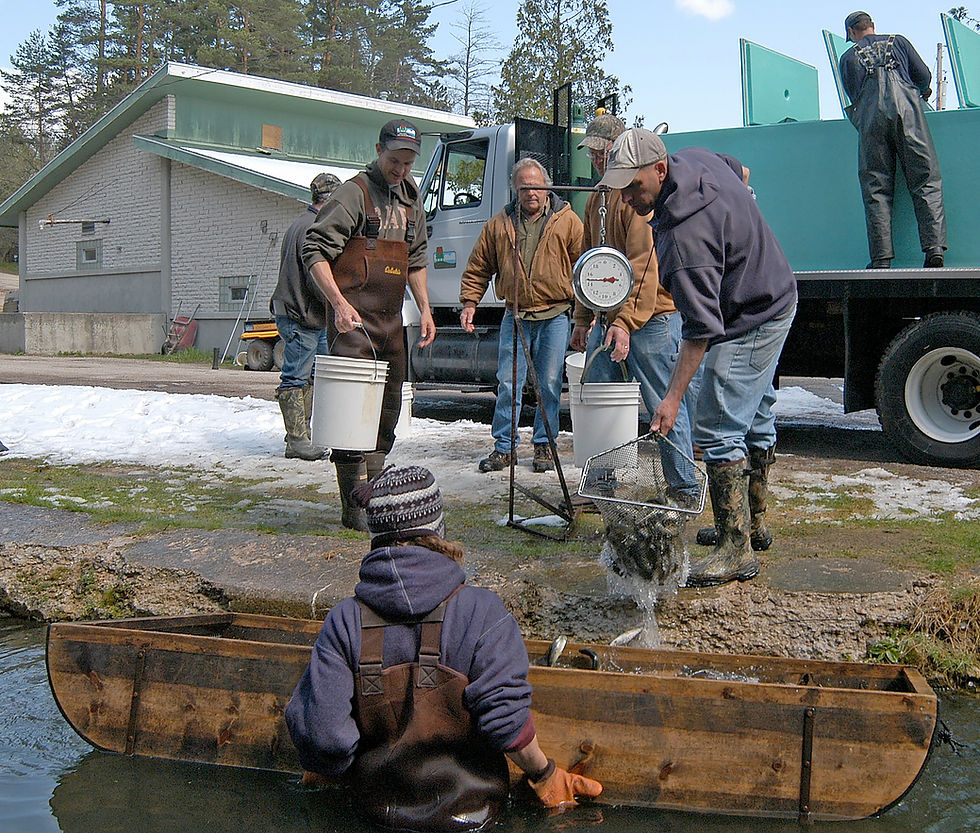
Wisconsin citizens voting in April’s annual fish and wildlife hearings supported several ways to boost funding for the state’s hunting and fishing programs, including fish rearing and stocking programs at state fish hatcheries. — Patrick Durkin photo
During April’s hearings, the NRB asked voters to consider various ways to raise more revenues, noting inflation has risen 22% the past 22 years. Voters favored raising hunting, fishing and trapping fees on a 3,263-1,888 vote (60% vs. 35%), with 251 (5%) neutral. They also supported (60-33-6) a one-time fee increase to address current budget shortfalls.
When asked specifics on possible fee increases, they supported a 25% increase by a 69-25-5 percentage; but split on a 50% increase with a 47-47-6 vote; while rejecting a 75% increase, 33-59-7.
Voters also supported (74-19-7) a $16 fee for Wisconsin’s inland trout stamp, whose $10 price hasn’t budged since 2006. They also supported (70-21-9) a $10 fee for the wild turkey stamp, which has been $5.25 since its creation in 1996, 30 years ago.
The NRB also asked four questions about alternative funding sources. Voters supported (75-20-5) adding a permanent 1/8-cent state sales tax (0.125%) to help fund all fish and wildlife conservation programs. They also supported (52-32-15) using general tax revenues to replace the $20 million lost each year because of existing free or discounted licenses, such as for senior citizens and first-timer hunters.
Voters weren’t as enthusiastic about charging access fees to fishing, wildlife and natural areas, much like admission fees at state parks. That idea narrowly won the popular vote by a 48-46-6 percentage, but lost 32-37-3 at the county level.
And when asked if Wisconsin should charge registration fees for non-motorized watercraft such as canoes, kayaks, rowboats and stand-up paddle boards, voters said no by a 37-57-4 percentage, with 60 counties rejecting the idea.

In other questions, voters …
-- Supported (65-14-21) opening the cottontail rabbit season statewide Sept. 15. Since 1949, southern Wisconsin has opened rabbit season Oct. 15, even though there’s no biological reason for the delay;
-- Supported (53-33-13) extending the archery and crossbow seasons to Jan. 31 in all farmland deer-management units;
-- Rejected (37-50-13) a proposal to allow bobcat hunting at night but only with calls (no hounds);
-- Supported (55-21-24) letting anglers on lakes Michigan and Superior clean salmon and trout on their boats, and drop the waste overboard at least a half-mile from shore;
-- Supported (41-27-32) opening an underwater spearfishing season for catfish;
-- Supported (72-12-5) requiring at least one blade on wind turbines to be painted dark to reduce bird-strike fatalities;
-- Supported (81-9-10) legislation to reauthorize the Knowles-Nelson Stewardship program for at least 10 years with up to $1 billion in funding;
-- Supported (59-28-13) letting houndsmen work with livestock owners and pet owners to use trailing hounds to harass wolves that kill or injure pets, cattle, horses or other animals;
-- Rejected (36-49-15) letting hunters leave stands or ground blinds overnight on all state-owned land, not just those north of Highway 64.
Hit this link for all votes at April’s hearings: https://widnr.widen.net/s/ftcrxwwxrg/2026springhearingstateresults.
Voters also weighed in on 182 resolutions submitted by citizens in individual counties. Of those resolutions, 52 came from counties supporting the Knowles-Nelson Stewardship program, with 90.3% of voters supporting the funding and 4.9% opposing.
Another 27 resolutions came from counties hoping to restore the split-zone muskie-fishing season, which Wisconsin ended starting with this year’s statewide opening May 2. From 1984 through 2025, the state opened the northern muskie-fishing zone on the Saturday of Memorial Day weekend, about three weeks after the general game-fish season opener.
Of the 27 counties favoring the traditional split-season format, 86% of voters supported reverting, 8% opposed and 6% were neutral.
Wisconsin’s conservation hearings began in the 1930s when UW-Madison wildlife professor Aldo Leopold and his contemporaries sought to engage the public in conservation decision-making. Each year since, citizens have crafted and voted on proposals for rules or laws regulating Wisconsin’s hunting, fishing, trapping and environment.
This year’s attendance for the spring hearings, 6,866, was the lowest since Wisconsin added online voting in 2019. Participation that year (10,712) totaled 3,402 in person and 7,310 online. In 2018, the final year in which in-person voting was the only option, 6,893 attended the hearings. Covid-19 canceled all in-person voting in April 2020, forcing the DNR to offer only online voting from 2020 through 2023.
Online voting set a record 64,943 participants in 2020, driven largely by hunters who opposed a menu of possible changes to the state’s deer-season format. Participation declined in 2021, and has averaged 14,553 the past six years, with 95% coming through online voting.


Comments