Salmon Strike Twice During Final Hours of Daily Fishing Trips in Sitka

Cool, crisp air creeping across the boat’s stern near Sitka, Alaska, raised goose bumps on my forearms.
I shivered and considered retrieving my hooded rain-jacket from the nearby cabin. Instead, I rolled down my sleeves.
Sarah Farber, the charter boat’s captain, looked up from a fishing knot she was tying and explained the sudden chill without being asked.
“The fog’s coming back in,” she said, nodding toward a far-off haze blurring the Pacific Ocean’s western horizon.
Soon after, she told her deckhand, Jason Shindelar, to get ready to pull the anchor. I started reeling up my bait from nearly 500 feet below, as did Farber’s other three anglers, Charlie Pooch (pronounced “Poke”) of Minneapolis; John Kerwin of Tacomah, Washington; and Scott Moen of Shorewood, Minnesota.
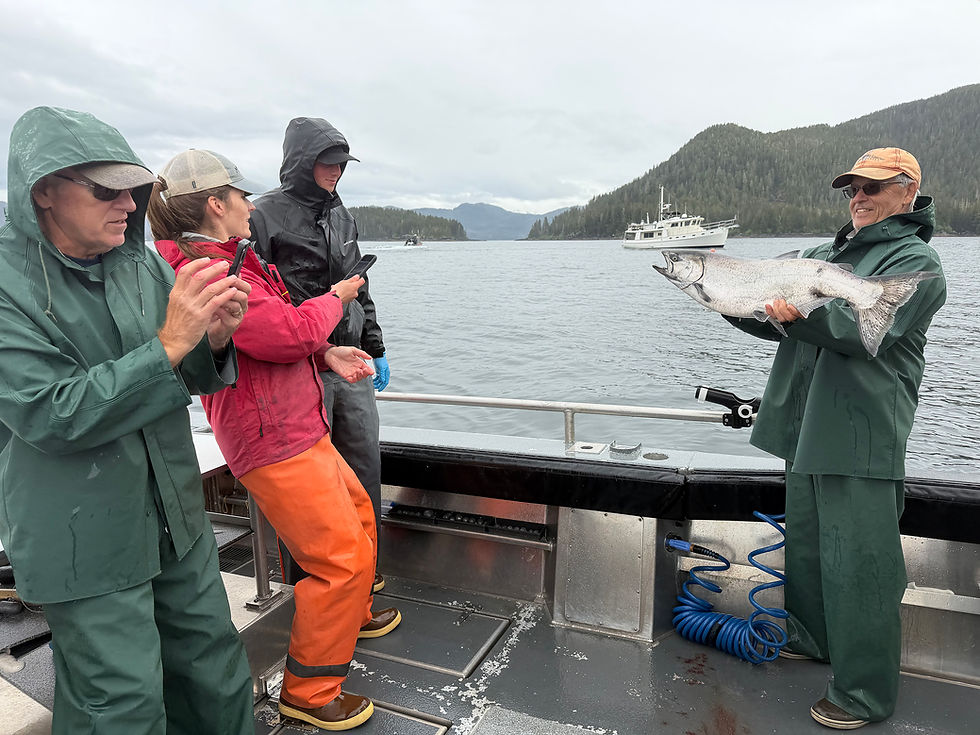
Charlie Pooch of Minneapolis, right, displays his last-minute chinook salmon after fishing near Sitka, Alaska, June 8 with his friend Scott Moen, left, Captain Sarah Farber and deckhand Jason Shindelar. — Patrick Durkin photos
We had spent the past hour catching halibut, Pacific cod and black cod (aka sablefish or butterfish), so I assumed Captain Sarah was abandoning our offshore hotspot to evade the incoming fog. But then I reconsidered. That couldn’t be it. After all, when Farber was monitoring her boat’s radar screen six hours earlier while navigating dawn’s early fogbanks, she barely mentioned the pea-soup visibility as we bounced toward the day’s first fishing site.
“So, what were you thinking when you pulled out of there just now,” I asked while settling into the passenger chair beside her.
“We have about 90 minutes to find some salmon before heading back to the dock,” she said. “We have our halibut and some cod, but now we need salmon.”
That made sense. We hadn’t caught one salmon early that morning when first targeting them, and we were allowed one chinook each. Our challenge also sounded familiar. The day before (Monday, June 8), we found ourselves one chinook short while racing inland a few miles for one last try before quitting time.

Captain Sarah Farber prepares to drop a heavy weight and bait for cod and halibut in 500 feet of water for Scott Moen of Shoreview, Minnesota.
Captain Sarah’s reasoning also reminded me why I’ll never be a fishing-boat captain. Her job requires too much time on the ocean; too many nautical and navigational skills; and too much experience making decisions based on the nuance of winds, tides, fish, fishing, client skills, ocean currents, daily schedules and water temperatures. Just to name a few.
Farber, who lives in Duluth, Minnesota, from late fall till early spring, accumulated all that expertise the past 14 years at Angling Unlimited in Sitka, where she first worked in 2013 as a hostess helping clients arrive and depart. The next year, at age 24, she transitioned from hostess to deckhand, which involves rigging lines, tying hooks, baiting hooks, netting fish, clubbing fish, filleting fish, scrubbing the boat, and repeatedly setting and retrieving an anchor and its hundreds of feet of line, chain and marker-buoy.
After Farber earned her captain’s license from the U.S. Coast Guard in 2017, her boss and owner of Angling Unlimited, Chuck McNamee, hired her fulltime in 2018 as one of his 11 boat captains, making her the only female in Sitka with that status.
Her experience showed when choosing where to fish for our fourth chinook during our final hour June 8. As midafternoon became late afternoon, Shindelar dropped the anchor when Farber nodded.
After dropping my bait 100 feet, I shuffled over in the bow to study Pooch’s “mooching” techniques, which were triggering more strikes than anyone else on board. Unlike my trips to Lake Michigan — where I mostly troll spoons, plugs and flies from downriggers, Dipsy Divers and trolling skis — Angling Unlimited’s boat captains prefer mooching. This hands-on method uses a half-pound weight on the main line, and a 7-foot dropline rigged with two Gamakatsu hooks that make a 6-inch herring spin as you lift or reel.

Mt. Edgecumbe is a dormant volcano on Kruzof Island, about 15 miles west of Sitka, Alaska. It hasn’t erupted for nearly 4,000 years.
Before I could ask Pooch my first question, I heard him hissing, “Hit it! Hit it!” while staring past his rod tip. As if taking orders, a chinook raced into view near the surface, slammed Pooch’s bait and torpedoed into the depths.
His reel screeched as the salmon peeled 20-pound line from its spool. Pooch patiently worked the king to exhaustion, keeping his line taut as the fish raced under the boat, around it and back again. Shindelar helped when possible, passing the rod under the anchor line, back to Pooch, around other fishing lines, and back to Pooch once more.
Finally, after about seven minutes of chaos, Pooch coaxed the salmon’s head to the surface and slid the fish within reach of Captain Sarah’s landing net. The boat erupted in cheers as she scooped it aboard to end our day.
And then, with 90 minutes remaining in our fishing day June 9, Farber had a bigger task: helping her four old-guy clients catch a salmon after getting skunked in the morning. With calmer waters and fewer competing boats, she decided to let her boat drift while we mooched.
Minutes later, my line gently tugged and went slack. I paused, raised my rod tip and reeled furiously, picturing a salmon attacking and engulfing my rising bait from below. The hooks took hold. The fight commenced.

Patrick Durkin and Captain Sarah Farber pose with a chinook salmon he hooked June 9 seconds after Farber saw the fish miss her bait yards from the boat.
“You broke the ice,” Pooch said as the chinook raced for Mt. Edgecumbe, a distant volcano now hidden by fog. When I worked the fish to the surface, Shindelar assessed its size and grabbed the boat’s smaller, rubberized net. “Looks a little small,” he said, knowing we’d release it for not meeting the 28-inch snout-to-tail size limit. Sure enough. It measured 26 inches.
When calm returned and persisted too long, Farber dropped a baited line, worked it back up, and yelled as a salmon struck but missed near the surface. Taking her cue, I cranked my bait to the salmon’s last reported sighting.
“Got ’im!” I yelled as the king rocketed away, melting line from my reel. When this king finally neared the boat, Shindelar grabbed the bigger net. As the fish hit the deck, he traded the net for a club.
Soon after, we had three of our four salmon, and Pooch was fighting the day’s final fish for the second straight day. His fish eluded the landing net three times before the boat erupted in whoops and cheers as Shindelar scooped the king and dumped it onto the wet deck.
This time, the goose bumps on my neck and forearms had nothing to do with cool ocean breezes.


Comments