Pesky Squirrels Sabotage Homemade Decoys Stacked in Backyard Shed

Someday — no time soon, I hope — one of my grandkids will inspect the contents of our backyard shed and say to their grandmother, “I never knew the grumpy ol’ coot was such a serious waterfowler.”
“He wasn’t,” Penny will respond. “At least not for long. Maybe 18 months? He spent the summers of 1982 and ’83 making all these duck and goose decoys. He even built a duck skiff in the summer of ’83 and tied 32 feet of wire-grass blinds that fall. Through it all, he spent the 1982 and ’83 waterfowl seasons wishing he were deer hunting. Bow, gun or muzzleloader. It didn’t matter. Deer. They made him stupid. Ducks and geese? Just a temporary distraction; a juvenile indiscretion.”
It’s true. I made roughly 50 duck decoys and 30 goose decoys out of 2-inch thick Styrofoam insulation boards in the summer of ’82. I cut those 4-by-8-foot sheets into rectangular blocks and glued them together, two blocks thick for duck decoys and three for geese. After shaping all the bodies with a wood rasp and sandpaper, I used a cheap bandsaw to cut the decoys’ heads and necks from chunks of 2-by-4 lumber.
I took pride in it all, sketching and cutting cardboard templates to make reasonable imitations of mallards, bluebills, canvasbacks and Canadas. I even made a small flock of buffleheads, just because I liked their looks; and a blue heron, just because “confidence decoys” supposedly tricked ducks.
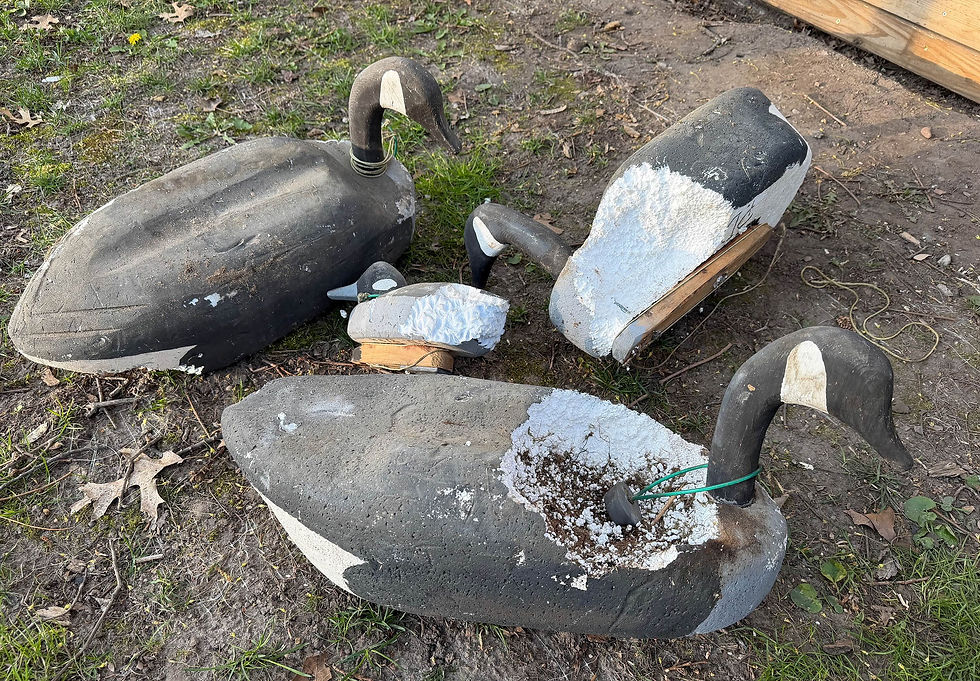
Squirrels carved a nest cavity into these decoys, which were stacked beside each other with dozens of other decoys in Patrick Durkin’s backyard shed. Then (below) the squirrels packed their excavation with a mass of fibers and threads they cut from a tarp inside the shed. — Patrick Durkin photos
For ballast, I drilled quarter-size holes into the decoys' wooden keels and filled them with melted lead from discarded wheel weights I bummed from Oshkosh-area gas stations. This was before convenience stores replaced gas stations, whose owners lived next door, and patched tires, cleaned carburetors and helped cheapskates crafting their own decoys.
After lining my dad’s garage and old boathouse on Lake Poygan with my flotilla — their pink, white or blue Styrofoam bodies still naked — I taught myself how to blend quarts of latex paints to match each species’ colors. And then I hand-painted them, one by one, with brushes that shed bristles so fast I thought they were molting. No doubt, I spent more time making those decoys than hunting with them.
Still, I never abandoned or gave them away. When we moved to Omro in 1985 from my parents’ summer house on Poygan, the decoys remained stacked, ready and mostly neglected in their boathouse. To wean myself from waterfowling the next decade, I toted around maybe a dozen or so to hunt geese in fields and mallards in sloughs.
I moved my entire decoy fleet to Waupaca in 1992, stacking them in the garage rafters atop two large pieces of plywood. I occasionally dragged out a bulging bag of Canadas for goose hunts on Waupun-area farms, but that enthusiasm waned, too.

When we moved to Eau Claire at the end of 2020, I didn’t forsake my decoys. I stacked them in neat rows in our old, drafty backyard shed, which had once been a chicken coop. The decoys shared the space with other seldom-used tools like a wheelbarrow, rusty lawn art and battered archery targets.
The storage arrangement seemed to be working, but then I noticed the neighborhood’s squirrels repurposed our shed for their apartment complex and playground. Plus, a previous owner had used the shed’s north side as the fourth side of a compost bin, and those boards were fast-becoming compost, too.
Sigh.
Nature’s assaults on our shed forced me to make repairs, replacing the rotting wall and the roof’s shingles. While moving the decoys around in early May as the work progressed, I noticed piles of white Styrofoam “peanuts” piled behind a pyramid of Canada dekes.
Hmm. All that chewed-up foam-plastic had to be from my decoys, but which ones? And how extensive was the damage? The answer emerged as I moved row after row of decoys to the opposite wall.
Two rows from the bottom, I found the squirrels’ victims. To create a nest, the vandals had hollowed out the left breast of one goose decoy, the upper back of another, and the port tail section of a female bufflehead. I only made those assessments after removing a squirrel nest built from a shredded mass of fibers, animal hair and canvas threads torn from an old tarp stored in the corner.
My first thought was to concede the loss and toss the three decoys’ remains into the garbage. But no. I can’t do that. With patience, my old wood rasp, and a can or two of foam-insulation patch, I’ll restore their “mothballed” status.
Plus, maybe one or more of my grandkids will become a waterfowler, and thank me one day for these stacks and bags of old, unique, seldom-used decoys.
Heck, if they’re patient in online auctions, they might even recoup a price comparable to what I paid for all the materials 44 years ago.


Comments