The North Can’t Rival the South for its Superstitions and Ghost Stories
- Patrick Durkin

- Jan 15
- 5 min read
As we work deeper into January, I’m reminded of past deer hunts this time of year in Alabama, Louisiana and Mississippi.
Photos and keepsakes from those hunts remind me how much the South’s culture differs from my own. Southerners seem more fascinated with death, superstitions and the afterlife than do most folks of the Upper Great Lakes.
For example, when I arrived at the Long family’s camp in Louisiana’s Atchafalaya Bayou in 2012, Mr. Raymond Long said I couldn’t hunt until signing the camp log. But when I sat by the logbook, picked up a pen and bit into a snack-bar, Mr. Raymond politely stopped me.
“If you’re going to eat at our dinner table, you have to hang your hat over there,” he said, pointing to several nails in the wall. “That’s our custom.”
Minutes later, Frank Pirie led me to the bunkhouse, and pointed out a bedpost nail for my hat. “Never lay your hat on your bed,” Pirie said. “You’ll bring bad luck to everyone.”
The next morning, as Pirie drove me to my treestand, he paused the utility vehicle in an opening and pointed to the skinny new moon above. “Never look at a new moon through tree branches,” Pirie instructed. “It’s bad luck. Move into a clearing before looking up.”
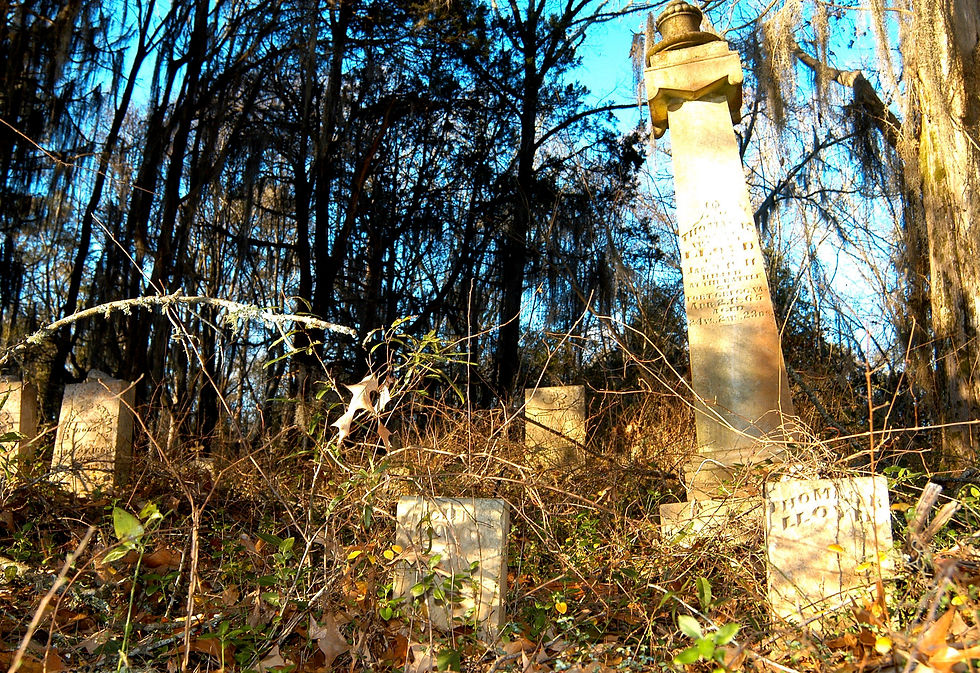
Patrick Durkin found this long-forgotten cemetery while bowhunting in Mississippi in January 2008. — Patrick Durkin photo
I laughed and said, “I don’t know if I can remember all this, Frank.”
As we continued, a rabbit hopped into view on our right. Pirie slowed the UTV. Rather than run in front of us, the rabbit reversed course and disappeared. Pirie accelerated while explaining why he had slowed.
“If a rabbit crosses the road from right to left, it’s bad luck,” Pirie said. “You might as well go back to camp. When we first saw that rabbit, he was in the right. But if he’d gone left, he’d gone wrong. That’s a bad sign.”
All those superstitions reminded me of a Southern writer named Betsy Cribb Watson, who believes superstitions finish a close second to the gospel among Southerners. Watson said she and her sisters grew up practicing hand-me-down superstitions “as matters of good hygiene.”
Superstitions can even portend death, y’know. If an empty rocking chair is rocking, someone will soon die. The same goes if you hear a screech owl’s screech, or if a bird gets inside your house or hits a window.
No wonder I felt spooked in 2008 when stumbling into a long-forsaken cemetery while bowhunting in Mississippi. Its headstones dated from the 1850s and 1860s, and appeared to identify family members. I passed through stealthily, fearing I’d annoy the souls by reading and photographing their weathered markers. After returning to camp, I asked our host about the overgrown cemetery. He said he knew little of its history, but promised I wouldn’t come near it in the dark.

Two ghosts reportedly roam this old house, which was built in 1854 by slaves in Alabama’s Sumter County. — Photo courtesy of the Library of Congress, Prints & Photographs Division, AL-290
And that reminded me of a 1999 bowhunt in a treestand overlooking an old gravesite in Alabama’s Sumter County. I hadn’t noticed the tomb when climbing into the treestand before dawn, but daylight revealed a large stone slab yards away. It sat askew atop a shallow-walled tomb, revealing a dark void beneath.
I averted my eyes, fretting I’d violate the dead person’s privacy. And I didn’t peer inside after descending. After all, the lodge’s chief guide had shared too much the night before about our quarters in the old antebellum house nearby. He claimed the place was haunted, which helped determine our mealtimes. He explained that the camp’s “help” — a cook and two maids — would arrive after dawn the next day. They’d serve breakfast after our morning hunts, and feed us an early dinner before our evening hunts.
“They’re never here alone or when it’s dark,” he said. “This place is haunted, and you’ll never convince them it’s not.”
I studied his face, assuming he was having fun with his Yankee guests. But his tone and demeanor differed little from his earlier introductions when explaining the lodge’s rules and Mississippi’s hunting regulations.
And then he cautioned us to not be shocked if we saw one or both of the house’s ghosts. He said the house was built in 1854 by slaves owned by Colonel Edward Lee, a cousin of Robert E. Lee, the famous Confederate general. Edward Lee’s spirit still occupied the place, as did the ghost of his great-granddaughter, Bessie Hudson. He said Miss Bessie’s dalmatians attacked and killed her on the premises in 1952.
“Weird stuff happens here, but don’t worry,” our host said. “The ghosts never hurt anyone. They scare someone every now and then if the person stays here alone, but y’all be sleeping together in the same big room.”
Fascinated, I asked, “What kind of things do they do?” Our host turned to his colleague, who said the ghosts preferred mischief over harm. He said they slammed doors, turned lights on and off, put flowers in vases, crossed creaky floors, and blasted the radio and TV late at night in unoccupied rooms. In fact, they sometimes triggered our host’s car alarm, which never sounds anywhere but outside this old house. In fact, our host once heard Bessie Hudson’s ghost calling his name when he was on the porch.
The men also recalled an old Ouija Board they tossed into the trash and hauled to the dump six times. Every time they returned from the junkyard, the Ouija board was already back on the kitchen table. Finally, they had someone burn it out back, and never saw it again.
They also recalled a 7-year-old boy who stayed overnight with his father. The boy knew nothing of ghosts. When his father awoke in the middle of the night, he realized his son wasn’t in bed, and heard faint crying. He found him cowering in the bathroom. The boy pointed down the hallway and said, “That lady in there won't talk to me!”
The boy said he had gotten up to go to the bathroom, and saw a woman in a rocking chair in a bedroom he passed. When his father checked the only door in the hallway, it was nailed shut. He calmed the boy and tucked him back into bed. Soon after, “Bessie Hudson” entered their room. They raced to their car, never to return.
Those stories ran through my head at bedtime an hour later. Two times that first night, I awoke aching to answer nature’s call, but couldn’t goad myself to leave my bed. After awakening a third time in severe pain at 3:30 a.m., I strode down the hallway to the bathroom. When I retraced my steps, I heard a loud radio in the unoccupied guest room to my left.
Unlike in the movies, I didn’t investigate. I returned to bed, trusting my two bunkmates to deter any ghosts between me and our door.


Comments