Marten, Ravens, Vultures Take Turns Trying to Scavenge Hunter’s Elk

Whether a bald eagle tears a wriggling fish from an osprey’s talons or an American marten steals elk meat from your cached game bag, you’re witnessing nature’s laws firsthand.
Nature’s children don’t respect our game regulations. They’ll forever ignore manmade items like carcass tags, no matter how visibly or securely we attach them. They’ll also scorn legal principles like “reducing prey to possession.”
After all, wild predators and scavengers — whether on foot or on the wing — only know nature’s harsh reality: Necessity knows no law. Their world is always “finders, keepers; losers, weepers.”
That’s why you can’t argue law and legal precedents with gray jays pecking fat from your buck’s brisket while it hangs on the meatpole. You also can’t convince coyotes to walk away from your deer if they find it before you unravel its track overnight.
Maybe that’s why my friend Mark Endris and I had to admire the strength and determination of a marten trying to drag a 3-foot section of an elk’s backstrap from our meat cache on Sept. 14. After I arrowed a young bull elk the previous evening in Idaho, Endris and I spent most of the night butchering the carcass and carrying away its meat, heart, liver, antlers and whistler teeth.

Six turkey vultures perch atop a dead tree, waiting to eat fat and waste-scraps trimmed from elk meat by nearby hunters. — Patrick Durkin photos
Oh, and we extracted its neck lymph nodes, too. Much like Wisconsin, Idaho asks hunters to provide samples to help its wildlife agency monitor chronic wasting disease.
After finishing our chores at the kill site and preparing to hike back to camp about 3:30 a.m., Endris and I moved all my meat bags 80 yards to the base of my treestand and stashed them beneath a tarp. Black bears roam the valleys and mountains of southeastern Idaho, and we assumed one would soon sniff the fresh elk carcass and entrails. If so, we didn’t want my family’s meat within paw’s reach of the elk's remains.
We returned about 8:30 a.m. after a nap and quick breakfast, stopping first at the carcass to see if anything was working on the elk’s bones and offal. Seeing nothing new, we walked toward our meat bags. As we neared, I saw a blur of fur racing from beneath the tarp.
I pointed and said, “Look at that marten!” It stopped about 15 yards away to study us. I yelled at it and threw a stick to scare it away. When I inspected the cache, I found one of the elk’s heavy backstraps halfway out of its bag, the prized meat covered in dirt, twigs and leafy debris. Endris and I were impressed. The biggest male martens only weigh about 3 pounds, and yet that critter tried stealing a meat chunk weighing over 10 pounds.
We repacked the meat and hiked four roundtrips to haul everything back to camp. We never saw the marten again. Once in camp for the day, we distributed the meat among three 65-quart coolers and topped them with ice. Should you be wondering, I use three coolers — one Grizzly and two Orions — for elk meat. I pack one of the coolers with frozen 1- and 2-gallon water bottles at home. A week to 10 days later, plenty of ice remains in the cooler to chill meat until we add new block ice before driving home.

Patrick Durkin trims and cleans meat from a bull elk he arrowed while bowhunting in southeastern Idaho in mid-September.
After resting that afternoon, I spent most of Monday, Sept. 15, trimming fat, gristle and membrane from the meat, flicking the waste into a plastic bag, and storing it inside a cooler overnight. Before resuming my knifework Tuesday morning, I carried the scraps about 150 yards behind camp and emptied the bucket at the woods’ edge.
As I finished trimming the remaining elk meat, I noticed several turkey vultures circling silently above camp, obviously zeroing in on the odors of fresh meat and the elk hide below. Turkey vultures boast the bird world’s largest olfactory system, and researchers have observed them detecting carrion from over a mile away. In a 1986 study cited by the University of Cornell’s ornithology lab, researchers hid 74 chicken carcasses to learn how well turkey vultures find fresh kills. Within three days, the vultures found 71 of the 74 carcasses (96%), whether the remains were hidden in brush or left in the open.
Our camp’s vultures never sang or called, of course. Their species has no voicebox. They can only hiss and grunt. Eventually, I saw one vulture gliding toward a tall, dead pine 50 yards from where I left the trimmings. After it landed and perched in the treetop, five other vultures soon joined it and perched below. When I turned to survey the ridgeline surrounding our camp, I saw four other vultures in another big tree, and two more perched nearby in a smaller tree.
Meanwhile, several rich-black ravens hovered around camp, calling often in their croaky, raspy voices before perching a few minutes in nearby aspens and lodgepole pines. As the ravens came and went, they sometimes harassed the vultures, which sat and watched as if knowing we would soon break camp and depart.
We wondered why all these ravens and vultures simply didn’t fly up the valley to the kill-site. The vultures could probably smell the elk’s distant remains, and the ravens probably heard the distant calls of their quarreling brethren as they fed.

A turkey vulture scavenges the site of an Idaho elk kill.
Either way, Endris and I didn’t ponder the scavenging traits of ravens and vultures for long. After hauling the last of the elk’s trimmings up the valley at 1 p.m., and dumping them alongside the earlier scraps, I returned to camp and started packing for home.
Although the ravens and vultures got to eat first from my bow-killed elk, my family and I will eat that elk's highest-quality meat for months to come.
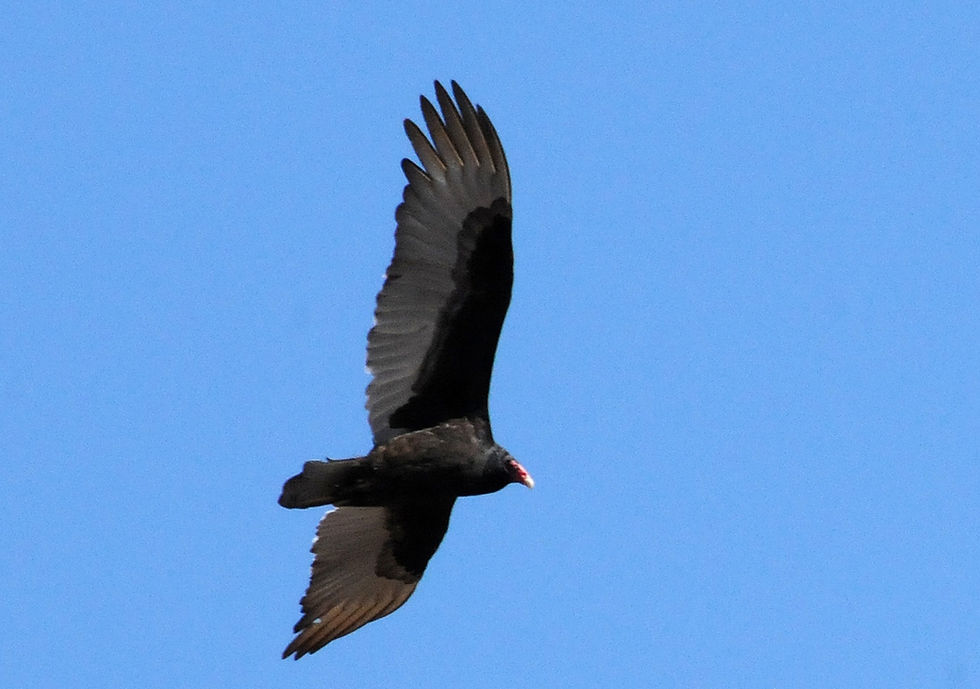
A turkey vulture soars above an elk kill, assessing possible danger from other scavengers feeding on the carcass.


Comments