Hunting Often Triggers Passions, Memories and Heart Attacks

When drinking coffee at breakfast or beer at dinner, my late friend Tom Heberlein liked discussing how and where hunters preferred to die.
Such talk at Old Tamarack — Heberlein’s hunting shack near Mellen, Wisconsin — was usually light-hearted. As Professor Heberlein knew too well, death isn’t something you schedule on calendars or choose from menus. By the time I became an Old T regular 25 years ago, he had long before buried his father and all the camp’s founders, friends, family and other originals.
Heberlein especially liked stories about hunters visiting their father, uncle or friend on their death beds, and requesting they send a big buck past them next deer season. He wondered why that was such a common bedside wish. Nothing he knew about Judeo-Christian beliefs suggests God grants the newly dead power over Earth’s creatures. And yet many hunters ask that favor during final visits with loved ones.
Then again, maybe they’re just making small-talk to convey love and affection they struggle to share. It’s easier than speaking from the heart, especially when others might eavesdrop.
Heberlein knew one thing for certain, though: He did not want to die while hunting, especially from a heart attack, whether from excitement or while dragging a buck to camp. “Who’d want to die that way?” he’d ask skeptically. “Heart attacks hurt! And they aren’t always quick! And it would ruin everyone else’s hunt!”
Then he’d clutch his chest in mock agony, buckle his knees and belt out his best death rattle.
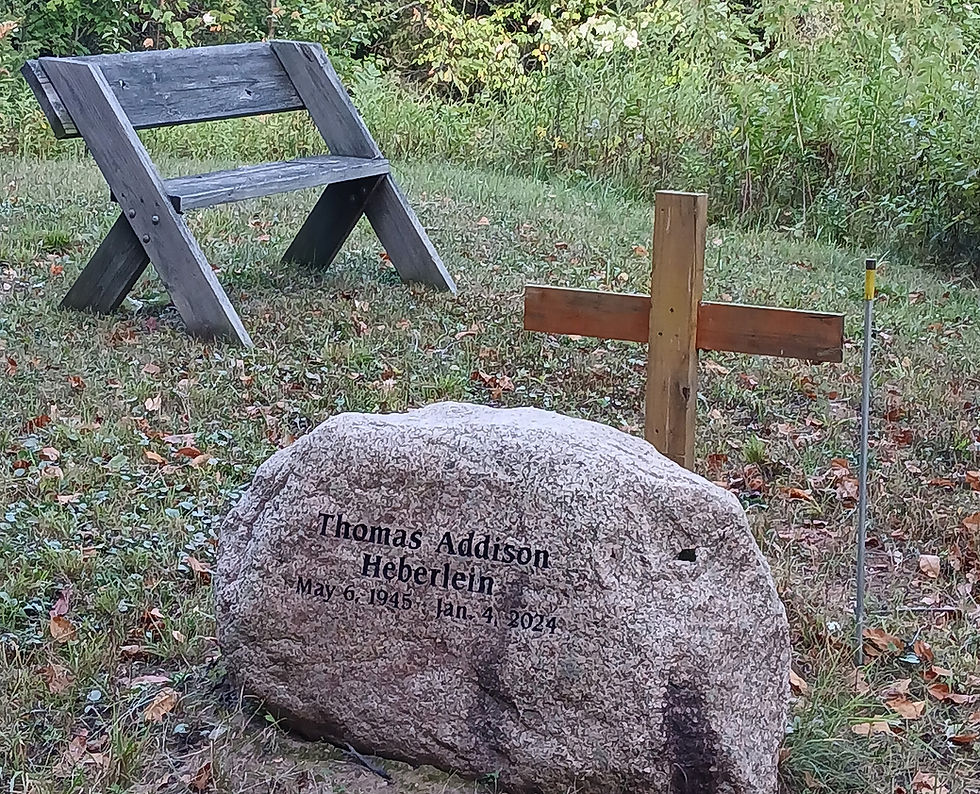
Tom Heberlein’s humble gravesite on his 40 acres near Mellen rests about 200 yards south of his old shack known as Old T. — Patrick Durkin photo
Honoring that theme, Heberlein sent me an email on March 6, 2019, after reading an obituary in the newspaper “Dagens Nyheter” in Stockholm, Sweden, where he lived much of the year. The obit told of a well-liked and respected 44-year-old man who worked hard helping vulnerable youths. The man had established a successful residential care home, and worked for the Swedish National Board of Institutional Care.
Heberlein respected all that, but that’s not why he sent the man's obituary and translated its highlights. He liked the obit’s conclusion, and knew I’d smile, too:
“On November 11 last year his heart suddenly stopped during an otherwise successful hunt with his friends.”
And then Heberlein asked the question all true hunters would ask: “What was he hunting?”
The obit never specified. I’d guess the poor guy’s “otherwise successful hunt” involved a deer species; either a moose, roe deer, fallow deer or red deer.
After all, when we read about hunting-related deaths, it usually involves deer, and it’s usually more from heart attacks or treestand falls than accidental shootings. Sometimes it’s even someone you know, such as my late friend Tom Tilkens, who died Nov. 8, 2017, at age 72 when dragging out a buck he arrowed while crossbow hunting in Michigan’s Upper Peninsula.
Plus, research in 1996 by Heberlein and his friend/colleague Rich Stedman found that deer hunters, more so than bird hunters, also suffer from “buck fever.” This instant and often convulsive adrenaline surge strikes hunters when they spot a deer and anticipate a shot.
Heberlein and Stedman weren’t just speculating from barstools at the Drop Tine Bar & Grill in Cayuga. They had data proving it. They had hooked heart monitors to 10 hunters to measure their responses during 56 hunts for ducks, deer, geese and upland birds (ruffed grouse and woodcock).
Their study found that deer hunters’ heart rates jumped an average of 33 beats per minute higher after spotting and shooting a deer. In contrast, heart rates jumped 28 beats for goose hunters, 22 for duck hunters and 10 for upland-bird hunters.
But Heberlein and Stedman also conceded theirs wasn’t a huge sample size, and they explained how responses can vary by the hunter’s age, fitness and experience. Wildlife managers, for instance, tend to be less excitable than their fellow hunters when spotting deer, waterfowl or upland birds, given their training, field work and professional detachment.
Further, hunting has infinite variables. Duck hunters, for instance, regularly out-sweat the average deer hunter. Waterfowlers often must work hard and hurriedly set decoys before first light, especially if they’re slogging through soft muck and knee-high waters in heavy, clumsy chest waders.
The late Don L. Johnson, a longtime Milwaukee Sentinel outdoors writer, once told me a story about a duck-season opener he covered in the 1960s. Johnson said he was hanging out at boat launch, interviewing hunters as they returned from nearby sloughs and marshes, probably along the Mississippi or lower Chippewa rivers. As they approached, Johnson took photos and helped tie their boats to the pier before retrieving his notebook and asking about their hunts.
After helping one crew tie off their duck boat and skiff, he was stunned when one of them said something like: “We had a great day, except Charlie died while we were setting up. We almost quit and came back, but then we talked about it. We agreed Charlie would have wanted us to stay and hunt. Either way, he wasn’t going anywhere. We’re glad we did. The ducks were really flying!”
What?! Johnson looked again at their boats, but didn’t see a body.
Two of the hunters rolled back one of their hand-tied wire-grass blinds. There lay ol’ Charlie in the bottom of the boat among some decoys, his cased shotgun tucked beside him.
Heberlein loved that story when I shared it years ago during an Old T visit. Unfortunately, I never thought to ask Johnson if he had written about it for the Sentinel, and he’s been gone since January 2006.
But I did think about all this a few weeks ago after clicking on an email from Heberlein’s wife, Betty. Her note included photos of Heberlein’s gravesite 200 yards south of his shack. The photos showed a newly engraved headstone, a flat-faced chunk of red granite that Old T’s caretaker, Al Conley, pulled from a nearby trail.
I hope Heberlein is pleased with his modest gravesite atop a knoll on Old T’s back 40. A heart attack didn’t put him there, and the site offers pretty views of each sunrise over the Chequamegon-Nicolet National Forest. Plus, visitors can watch while standing at attention, or relaxing on a Leopold bench Heberlein provided.
Just realize, of course, that Heberlein shoulders no obligation to send a big buck past any visitor, whether you’re there to hunt, trap, cut firewood or seek his counsel.
Heberlein cared most about hunting ruffed grouse. Woodcock, too.
He never fancied himself a deer hunter, and it’s too late to start now.


Comments