Fog, Rain and Rams Make Missouri Breaks a Memorable Misery

LEWISTOWN, Montana – Matt Williams and I found much to like and endure during our deer hunt in the Missouri River’s famous “Breaks in early November.
Williams’ tent didn’t leak, and neither did our rainwear.
We got along well, and our conversations didn’t bore our audience of two.
We seldom lost sight of a herd of bighorn sheep in the rugged cliffs and hilltops a half-mile south across the Missouri.
And though I saw neither a mule deer nor white-tailed deer, Williams usually made up for it. Whether meeting for sandwiches at lunch or freeze-dried meals at dinner, Williams offered hot tips for finding does, fawns and young bucks in the sage brush and jagged ravines north of camp.
But if there were any mature bucks — muley or whitetail — hiding in the Breaks, neither of us saw one. We didn’t blame the weather, though. I mean, we aren’t ingrates. After my ol’ Navy buddy from Bozeman, Montana, met me Nov. 1 in Lewistown, we fretted a bit about the grumpy clouds hovering all around, occasionally scowling and spitting drizzle as we drove north.

Patrick Durkin watches for deer while hunting “the Breaks” along the Missouri River in central Montana. — Matt Williams photo
The weather then took a break as we launched Williams’ boat, loaded our gear, jetted downriver a few miles and set up camp beneath a row of ancient cottonwoods. When the rain finally lost its patience, we pulled on our rainwear and trekked through mist and drizzle to hunt the day’s final hours.
We saw no deer.
The next morning, we hunkered inside our sleeping bags when waking to steady rain. We assured ourselves we needed the rest, and recalled the forecast called for clearing skies by midmorning. Sure enough, the rain eased an hour later while we ate breakfast and sipped coffee while seated cross-legged atop our air mattresses. By 8:15 a.m., Williams headed east and I walked west through the sagebrush flats.

Deer camp shrouded in dense fog along the Missouri River in central Montana.
— Patrick Durkin photos
Williams saw some distant does for his troubles, while I conducted a census of a prairie dog colony a half-mile from camp. Little changed during our afternoon hunts, and so we crawled back inside the tent at dark for dinner and a bourbon.
Given how few trees border the Missouri in that area, we weren’t surprised to learn owls congregate there to hoot deep into the night. Perhaps they were just complementing the neighborhood coyotes, which howled continually just upriver of us.
I awoke the next morning with a feeling of cold, wet fabric pressed against my bald head. Puzzled, I reached up, thinking the tent had sprung a leak. But no. Temperatures in the river bottoms had dropped into the 20s, freezing condensation across the tent’s nylon shell. Relieved, I crawled out of the tent to survey the cold dawn.
While crawling back inside minutes later, I heard Willliams ask: “Is it still foggy? It was pea soup out there when I checked.”
No. It was clear and frosty. “Crisp” kind of defined things.
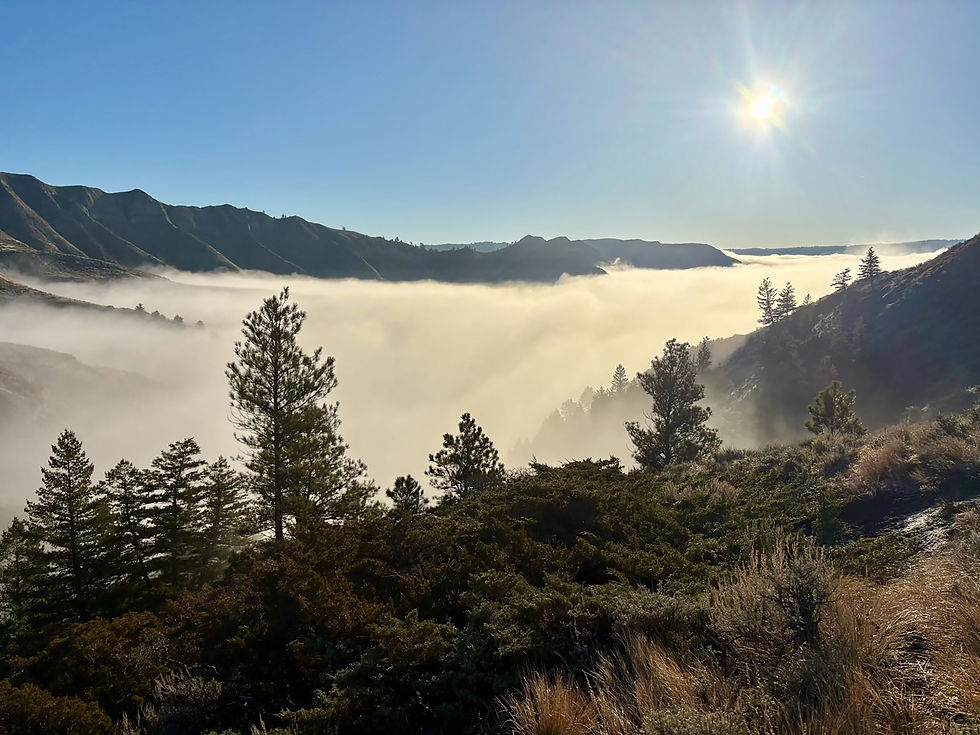
Fog blankets the Missouri River’s valley in central Montana north of Winifred.
And so, we ate our breakfasts of instant oatmeal and Clif bars, and discussed where to hunt. But when we crawled out with our backpacks, Williams’ fog had returned to greet us, along with an icy wind blasting up the river. I wasn’t dressed for that, so Williams set off while I donned rainwear to cut the icy wind.
That done, I hiked upriver a mile, thinking the fog would surely lift soon. If/when it did, I planned to watch an island of cottonwoods midstream in the Missouri, and a large cottonwood bottoms along its flank. Instead, I sat nearly blind in the fog nearly three hours, waiting for sunlight to burn it off and reveal deer browsing in those cottonwood corridors.
To my greater surprise, the fog didn’t slow a jet-boat flying downriver. I imagined its driver studying his boat’s sonar and GPS screen, trusting its electronic route tracker to keep him safe from rocks, logs and sandbars. Though I was only 100 yards from the river, I could barely glimpse the boat as its driver sped through the fog, blindly believing no other boat was on the river.
And maybe there wasn’t. But I had seen rocks and a wide, choppy shallows while hiking the nearby shoreline two hours earlier. Sure enough, a loud “THUNK” rolled through the fog, and then the sound of a stricken boat engine, coughing and chugging to a halt. Minutes later, I heard the engine start, stop, cough and groan again before silence prevailed. A few minutes passed before the sequence repeated, and then repeated again. And again.
When the fog vanished for good around noon, I started hiking back to camp. The boat and its two occupants were now chugging upriver, the driver seemingly whipping the crippled engine at every step. We exchanged waves but didn’t attempt conversation. I let them think I hadn’t heard the whole thing.
Williams and I decided during lunch to break camp and head west to his cabin in the Little Belt Mountains and the Lewis and Clark National Forest. In between lunch and packing our bags, we paused to use binoculars to relocate the herd of wild sheep south of us. Only a lucky few hunters draw tags each fall to hunt the Breaks’ famous bighorns. In fact, the tags are so limited I’ve never bothered applying.
Late that afternoon, we left the river and drove south toward Winifred, pulling Williams’ boat past ranchers’ fields and road crews laying fiber-optic cables. Every other field seemed to hold mule deer and occasionally some wild sheep. We agreed there’s no animal more regal and stunning than a full-curl ram.

A bighorn ram crosses a rancher’s field south of the Missouri River.
As if on cue, Williams spotted a big ram 100 yards away, casually crossing a field. Williams stopped the truck and said I’d probably never get a better chance to photograph a bighorn ram.
I felt inadequate scaling the small hill between the road and ram, clutching only my iPhone 17 Pro. Why hadn’t I brought my “real” camera and its expensive zoom lens?
I did what I could with what I brought. Still, it was further proof why I’ve never been a wildlife photographer.


Comments